
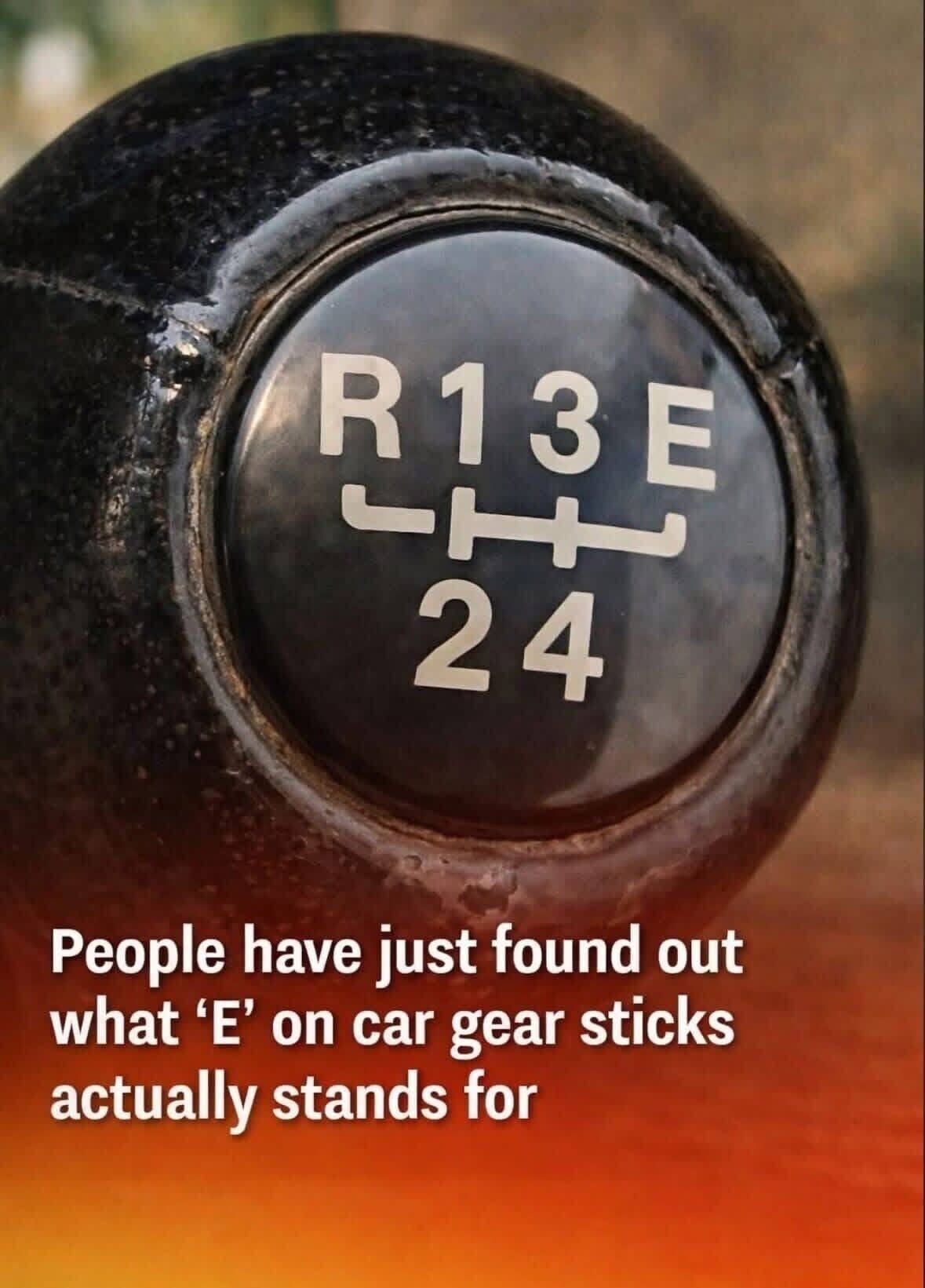
For decades, driving has followed a kind of universal language. Whether someone learned to drive in Europe, the United States, or anywhere else in the world, the basic layout of gear sticks felt familiar. Manual cars came with numbered gears and a reverse, while automatic transmissions simplified everything into a few letters: Park, Neutral, Drive, and Reverse. This consistency made it easy for drivers to switch between vehicles without much confusion. But every now and then, something unusual appears—something that breaks that familiar pattern. That’s exactly what happened when drivers began noticing a mysterious letter “E” on certain older gear sticks. For many, especially younger drivers, it looked completely out of place, almost like a mistake or a forgotten symbol from another system. Naturally, curiosity took over, and people began asking the same question: what does “E” actually mean?
The confusion didn’t stay limited to a few individuals. It quickly spread online, where discussions turned into debates. Some people guessed it might stand for “extra,” others thought it could be related to emergency driving, and a few even assumed it was connected to electric functionality. The mystery gained even more attention when it appeared in a social media discussion that asked drivers directly if they knew its purpose. What followed was a mix of amusement and surprise. Experienced drivers, especially those familiar with older European cars, stepped in to explain that the “E” stood for “Economy.” Suddenly, what seemed like a strange and unexplained marking became something surprisingly practical. It wasn’t random at all—it was a deliberate feature designed to help drivers save fuel at a time when efficiency wasn’t as automated as it is today.
Continued On Next Page
ADVERTISEMENT

